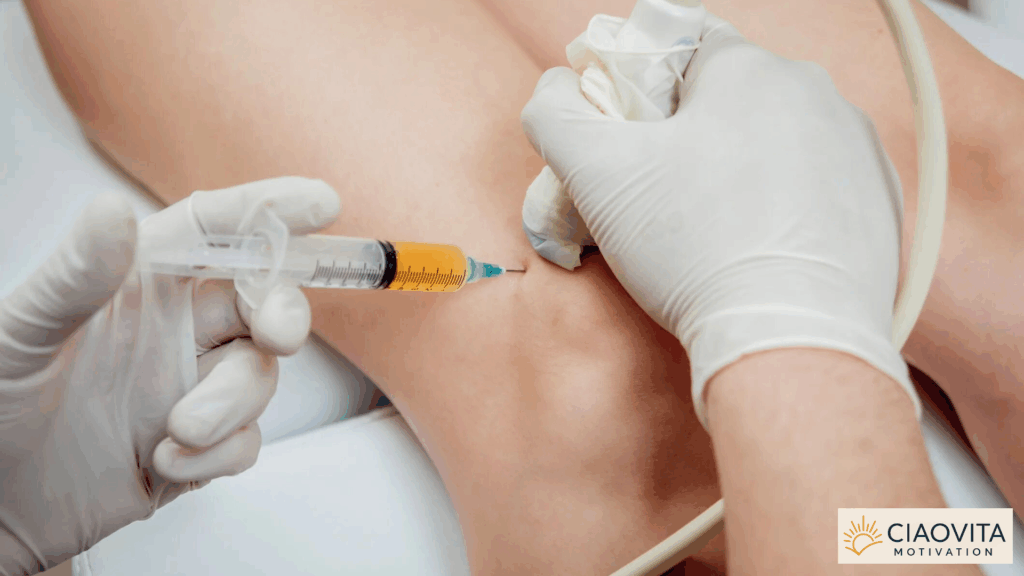
Platelet-Rich Plasma: A Promising Hope for Knee Pain.
Could Your Own Blood Hold the Key to Healthier Knees?
Imagine if relief from your chronic knee pain was already flowing through your veins. Platelet-rich plasma therapy harnesses your body’s natural healing mechanisms to reduce inflammation, protect cartilage and potentially delay knee replacement surgery for years. Recent umbrella reviews analyzing over 32,000 patients confirm this treatment works significantly better than alternatives like hyaluronic acid and corticosteroids.
What Makes Platelet-Rich Plasma Different from Other Treatments
Your blood contains remarkable healing potential beyond what most people realize. Platelets are small cell fragments that rush to injury sites, releasing growth factors that orchestrate tissue repair. PRP therapy concentrates these platelets to 1.5 to 5.5 times normal blood levels, creating a powerful regenerative solution doctors inject directly into damaged knee joints.
The process begins with drawing a small blood sample, typically less than 60 milliliters. Technicians spin this blood in a centrifuge, separating components by weight and density. The platelet-rich layer gets carefully extracted, sometimes activated with calcium or thrombin, then prepared for injection. The entire preparation takes under an hour at most medical facilities.
Understanding the gut-brain connection helps explain why systemic inflammation affects joint health. Your knee doesn’t exist in isolation. The inflammatory molecules circulating through your bloodstream influence cartilage breakdown and pain perception throughout your body.
The Umbrella Review That Changed Everything
In 2024, researchers published a comprehensive umbrella review examining 28 meta-analyses involving 32,763 participants. This represents the highest level of scientific evidence available, synthesizing data from systematic reviews and meta-analyses rather than individual studies. The findings were remarkable and consistent across multiple outcome measures.
PRP therapy significantly improved visual analog scale pain scores compared to control groups. The WOMAC total score, which measures pain, stiffness and physical function, showed substantial improvement at both 6 and 12 months. Patients receiving PRP injections reported better quality of life and enhanced knee function measured by standardized assessment tools.
The efficacy increased with treatment duration. Three-month follow-ups showed modest improvements, but benefits became more pronounced at six months and peaked around the one-year mark. This temporal pattern suggests PRP initiates biological changes that continue developing over time rather than providing immediate symptomatic relief like pain medications.
Most importantly, the umbrella review found PRP therapy particularly effective when using leukocyte-poor formulations. These preparations filter out white blood cells that can trigger inflammatory responses, leaving concentrated platelets and their beneficial growth factors. Patients with mild to moderate osteoarthritis, classified as Kellgren-Lawrence grades I through III, responded best to treatment.
How Platelet Concentration and Dosing Affects Outcomes
Not all PRP formulations deliver equal results. A 2025 systematic review specifically examined how total deliverable platelets influence knee osteoarthritis outcomes. Researchers classified treatments into three dosing categories based on total platelet counts injected into joints.
Low-dose treatments delivered 1 to 5 billion platelets per injection. Moderate-dose protocols provided 5 to 10 billion platelets. High-dose formulations exceeded 10 billion platelets per treatment. The analysis revealed optimal results occurred with moderate dosing between 5 and 10 billion total platelets.
Doses below this threshold provided insufficient growth factor concentrations to trigger robust healing responses. Surprisingly, doses significantly exceeding 10 billion platelets didn’t improve outcomes further and occasionally correlated with increased inflammation. This suggests an optimal biological window exists where platelet concentrations maximize benefits without triggering counterproductive immune responses.
The preparation method matters tremendously. Some systems use single-spin centrifugation producing lower platelet concentrations around 1.5 to 2 times baseline. Double-spin methods achieve higher concentrations of 3 to 5.5 times normal levels. Most successful protocols in research studies used double-spin preparations with moderate platelet doses, supporting the importance of proper preparation techniques.
Comparing PRP Performance Against Standard Treatments
The 2023 systematic review published in The American Journal of Sports Medicine directly compared PRP against other nonsurgical knee osteoarthritis treatments. This meta-analysis evaluated benefits and potential harms using the GRADE system for assessing evidence quality.
Results demonstrated PRP intra-articular injections produced significantly better outcomes than placebo at 12-month follow-up. When compared directly to hyaluronic acid, PRP showed superior results at both 6 and 12 months using WOMAC scoring. The differences weren’t marginal. PRP reduced pain scores by additional 15 to 20 points on 100-point scales compared to hyaluronic acid at one year.
Comparisons against corticosteroid injections revealed interesting patterns. Steroids provided faster initial relief within the first month, but effects faded quickly. PRP took longer to produce noticeable improvements, typically requiring 6 to 8 weeks before patients reported significant benefits. However, PRP effects lasted substantially longer, often persisting beyond 12 months while steroid benefits rarely extended past 3 months.
The role of stem cells in joint repair complements PRP therapy. Some clinicians combine both approaches, though research hasn’t definitively proven combination treatments outperform PRP alone. The 2024 umbrella review found similar improvement rates whether patients received PRP exclusively or PRP plus mesenchymal stem cells.
Understanding the Biological Mechanisms Behind PRP Benefits
Scientists have identified multiple pathways through which platelet-rich plasma influences knee joint health. Laboratory studies analyzing synovial fluid before and after PRP treatment reveal consistent molecular changes that explain clinical improvements.
Inflammation reduction represents one primary mechanism. PRP lowers concentrations of interleukin-1 beta and tumor necrosis factor alpha, two inflammatory molecules that accelerate cartilage breakdown in osteoarthritis. Studies measuring these markers found 30 to 40 percent reductions following PRP treatment compared to minimal changes with placebo injections.
Cartilage protection occurs through multiple pathways. Growth factors released from platelets include platelet-derived growth factor, transforming growth factor-beta, and insulin-like growth factor. These molecules stimulate chondrocytes, the cells responsible for maintaining cartilage matrix. Laboratory experiments show PRP reduces expression of enzymes like matrix metalloproteinases that degrade cartilage structure.
Improved lubrication helps reduce friction during movement. Research demonstrates PRP enhances production of superficial zone protein, which acts as a natural lubricant coating cartilage surfaces. Better lubrication means less mechanical irritation with each step you take, potentially slowing disease progression.
New blood vessel formation improves nutrient delivery to healing tissues. Vascular endothelial growth factor from platelets promotes angiogenesis in areas surrounding damaged cartilage. While cartilage itself lacks blood vessels, improved circulation in nearby bone and synovial tissue supports overall joint health.
The connection between metabolism and joint health influences PRP treatment response. Patients with well-controlled blood sugar, healthy body weight and low systemic inflammation typically experience better outcomes than those with metabolic dysfunction.
Multiple Injections Produce Better Long-Term Results
A comprehensive 2023 meta-analysis compared single PRP injections against multiple-dose protocols. The findings clearly favored repeated treatments over one-time applications. Patients receiving three injections spaced 2 to 4 weeks apart experienced significantly better pain reduction and functional improvement at 6 and 12 months compared to single-injection groups.
This makes biological sense. Growth factors released from platelets have relatively short half-lives in joint fluid, typically degrading within days to weeks. A single injection creates temporary improvement in the joint environment, but effects fade as growth factor concentrations decline. Repeated treatments maintain higher levels of beneficial molecules, giving tissues sustained support for healing and regeneration.
The optimal injection schedule remains under investigation. Most successful protocols used 3 to 5 injections delivered at 1 to 4-week intervals. Some practitioners prefer weekly injections for 3 consecutive weeks, while others space treatments 2 to 4 weeks apart. Research hasn’t identified one superior schedule, but the principle of repeated dosing consistently outperforms single applications across multiple studies.
Maintenance injections may extend benefits. Some physicians recommend annual or biannual PRP treatments after completing the initial series, particularly for patients who responded well initially. Limited research has examined this maintenance approach, though anecdotal reports suggest periodic treatments help sustain improvements over multiple years.
Which Patients Benefit Most from PRP Therapy
Not everyone with knee osteoarthritis responds equally well to platelet-rich plasma treatment. The 2025 narrative review synthesizing 40 high-quality studies identified several factors predicting treatment success.
Disease severity strongly influences outcomes. Patients with Kellgren-Lawrence grade I or II osteoarthritis, representing mild disease with minimal cartilage loss, achieved the best results. Grade III patients with moderate damage still benefited significantly. Grade IV patients with severe osteoarthritis and bone-on-bone contact showed minimal improvement, suggesting PRP works best when adequate cartilage remains to protect and support.
Age correlates with response, though perhaps not as directly as you might expect. One large analysis found average age of successful responders was 67 years compared to 71 years for non-responders. This 4-year difference seems modest, but it likely reflects disease duration and severity more than age itself. Younger patients tend to have less advanced damage, giving PRP more biological material to work with.
Body mass index affects treatment outcomes. Multiple studies report better results in patients with BMI under 30 compared to those with obesity. Excess weight increases mechanical stress on knee joints and promotes systemic inflammation that counteracts PRP’s anti-inflammatory effects. The relationship between weight and joint health means addressing obesity improves PRP effectiveness.
Previous treatments matter less than you might think. Whether patients had tried hyaluronic acid, corticosteroids, or physical therapy before PRP didn’t significantly predict response rates. This suggests PRP offers benefits through distinct mechanisms rather than simply being a stronger version of other conservative treatments.
Safety Profile and Realistic Expectations
PRP therapy demonstrates excellent safety across multiple studies. The 2024 umbrella review analyzing thousands of patients found minimal serious adverse events. Common side effects included temporary pain at injection sites, mild swelling lasting 1 to 3 days, and occasional bruising. Serious complications like infection or allergic reactions occurred in less than 0.5 percent of treatments.
The autologous nature of PRP provides inherent safety advantages. Using your own blood eliminates concerns about disease transmission or immune rejection that accompany treatments derived from donor tissues. Your body recognizes and accepts its own cells, reducing complication risks.
However, PRP isn’t a miracle cure, and setting realistic expectations proves crucial. This treatment won’t regenerate severely damaged cartilage or restore your knee to 20-year-old condition. What it can do is reduce inflammation, protect remaining cartilage, improve lubrication, and potentially slow disease progression. For many patients, these benefits translate to meaningful pain reduction and improved function that delays or possibly prevents the need for surgery.
Cost presents a practical consideration. PRP treatments typically aren’t covered by insurance for knee osteoarthritis, leaving patients to pay out of pocket. Prices vary widely from $500 to $2,000 per injection depending on location and facility. A typical three-injection series might cost $1,500 to $6,000 total. While expensive, this remains substantially less than knee replacement surgery costs ranging from $20,000 to $50,000.
Standardization Challenges and Future Directions
The biggest challenge facing PRP therapy involves lack of standardization. Different medical centers use various preparation systems, resulting in PRP products with divergent characteristics. Platelet concentrations range from 1.5 to 8 times baseline. White blood cell content varies from essentially zero in leukocyte-poor formulations to higher than normal blood in leukocyte-rich preparations. Growth factor profiles differ based on individual biology and preparation methods.
This variability makes comparing studies difficult and raises questions about which formulation works best. The emerging consensus from recent research favors leukocyte-poor preparations with moderate platelet concentrations around 3 to 5 times baseline. However, definitive head-to-head trials comparing different formulations remain limited.
Activation methods add another variable. Some practitioners activate PRP with calcium chloride or bovine thrombin before injection, while others inject unactivated preparations. Theoretical arguments support both approaches, but clinical evidence hasn’t clearly demonstrated superiority of either method.
Research continues examining optimal protocols. Ongoing studies investigate combination approaches like PRP with bone marrow aspirate concentrate, different injection techniques including ultrasound guidance, and adjuvant therapies like exercise programs or nutritional interventions to enhance results.
The American College of Rheumatology and Arthritis Foundation have recommended PRP injections for knee and hip osteoarthritis since 2019, though they note limitations in current evidence quality. European societies like ESSKA have adopted more favorable positions based on accumulating positive research. As evidence continues strengthening and protocols become more standardized, PRP will likely gain wider acceptance in mainstream orthopedic practice.
Conclusion
Platelet-rich plasma represents a promising therapeutic option for knee osteoarthritis that harnesses your body’s intrinsic healing capabilities. Umbrella reviews analyzing tens of thousands of patients confirm PRP reduces pain, improves function, and helps many individuals delay or avoid knee replacement surgery. The treatment works particularly well for mild to moderate osteoarthritis when delivered using leukocyte-poor formulations at moderate platelet doses through multiple-injection protocols.
While PRP won’t cure advanced arthritis or completely regenerate damaged cartilage, it offers meaningful benefits for appropriate candidates. The therapy demonstrates excellent safety with minimal side effects, and emerging evidence supports its superiority over traditional conservative treatments like hyaluronic acid and corticosteroids. As research continues refining optimal protocols and standardizing preparation methods, PRP therapy will likely play an increasingly important role in managing knee osteoarthritis. For those dealing with chronic knee pain who want to exhaust conservative options before considering surgery, platelet-rich plasma deserves serious consideration as part of a comprehensive treatment strategy.
References
- Lin F, Zhang X, Cui C. Mesenchymal stem cells and platelet rich plasma therapy for knee osteoarthritis: an umbrella review of systematic reviews with meta-analysis. Ann Saudi Med. 2024;44(3):195-211.
- Platelet-Rich Plasma for Knee Osteoarthritis: A Comprehensive Narrative Review of the Mechanisms, Preparation Protocols, and Clinical Evidence. PMC. 2025.
- Costa LAV, Lenza M, Irrgang JJ, Fu FH, Ferretti M. How Does Platelet-Rich Plasma Compare Clinically to Other Therapies in the Treatment of Knee Osteoarthritis? A Systematic Review and Meta-analysis. Am J Sports Med. 2023;51(4):1074-86.
- Platelet-rich plasma outcomes in knee osteoarthritis are associated with the amount of total deliverable platelets: A systematic review and meta-analysis. 2025. PMID:40980
- Filardo G, Previtali D, Napoli F, Candrian C, Zaffagnini S, Grassi A. PRP Injections for the Treatment of Knee Osteoarthritis: A Meta-Analysis of Randomized Controlled Trials. Cartilage. 2021;13(1_suppl):364S-375S.
© 2025 Alice & Marcus Guimarães. All rights reserved.This site is proudly created with WordPress.