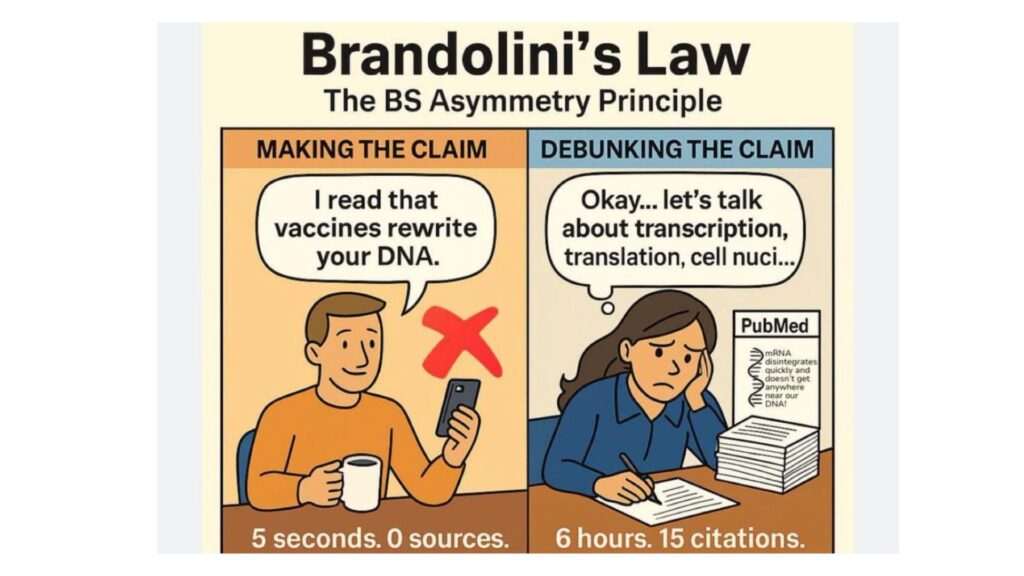
Brandolini’s Law: Why Debunking Nonsense Takes So Long. The Science Behind the Bullshit Asymmetry Principle.
In January 2013, Italian programmer Alberto Brandolini posted a line on Twitter right after watching an Italian political talk show. It read: the amount of energy needed to refute bullshit is an order of magnitude bigger than to produce it. That sentence is now known as Brandolini’s Law, or the bullshit asymmetry principle. It started as an internet joke, but a decade of research has turned it into something closer to a measurable fact.
A Twitter dataset that measured the gap
In 2018, three MIT researchers, Soroush Vosoughi, Deb Roy, and Sinan Aral, published a study in Science that tracked about 126,000 true and false stories shared on Twitter between 2006 and 2017, involving roughly 3 million people and more than 4.5 million shares. False news reached more people than the truth, spread faster, deeper, and more broadly across every category, and the gap was widest for false political stories. False stories were also more novel than true ones, which helps explain why people were quicker to pass them along.
One detail stands out. True news rarely reached more than 1,000 people. The top 1% of false-news cascades reached between 1,000 and 100,000 people. That’s not a small difference, it’s an order of magnitude, exactly what Brandolini guessed at years before anyone had the data to prove it.
- Falsehood spread farther, faster, and deeper than the truth in every category tested
- The effect was strongest for false political news, weaker for science or natural disasters
- Novelty, not bots, appeared to be the main driver behind the spread
Why a correction alone rarely works
Knowing that something is false doesn’t make people stop believing it. That’s the core finding of a widely cited 2012 review in Psychological Science in the Public Interest, led by Stephan Lewandowsky. The authors describe the “continued influence effect”: even after a clear retraction, people keep relying on the original false information in their reasoning, because the brain prefers a complete mental model, even a wrong one, over one with a gap in it.
This explains why simply saying “that’s not true” does so little. What works is offering a plausible alternative that fills the gap the false claim leaves behind. Telling someone a missing plane wasn’t hijacked leaves an open question in their head. Giving them a concrete alternative explanation works far better.
Bullshit in science, not just on social media
In 2016, psychologist Brian Earp published an essay, later carried by the BMJ’s medical ethics blog and by Practical Ethics at the University of Oxford, titled “The Unbearable Asymmetry of Bullshit.” Earp applies Brandolini’s Law directly to scientific research. Some published studies look solid, well-argued, backed by data, yet fall apart under close scrutiny. Earp calls this scientific bullshit, not because it’s a deliberate lie, but because it wears the appearance of truth without the substance.
The problem, Earp writes, is that dismantling one of these papers takes technical skill, time, and patience, while producing it only takes a willingness to ignore your own method’s limits. He argues that tackling this asymmetry should become a priority for publication ethics, not a side task left to a handful of patient reviewers.
Box — The Gish Gallop
A rhetorical tactic often mentioned alongside Brandolini’s Law is the “Gish Gallop”: firing off many weak or false claims in rapid succession, so an opponent never gets time to refute them all in a debate. Each point takes seconds to state and minutes to properly take apart.
Why bullshit persuades even without evidence
In 2021, social psychologist John Petrocelli of Wake Forest University published a study in the British Journal of Social Psychology on what he calls “bullshitting”: communicating with little to no regard for the truth, not necessarily lying, just not bothering to check whether a claim holds up. In his experiments, this kind of talk was often just as persuasive as evidence-based argument, especially when the real evidence available was weak.
That finding helps explain why Brandolini’s Law works so well on social media. Someone spreading a false claim doesn’t need to check anything, a confident tone is enough. Someone trying to correct it has to verify sources, check the data, and the finished correction often sounds more cautious, less certain, less “shareable” than the original post. The gap in effort isn’t only technical, it’s also a gap in communication style.
A concrete example from orthopedic practice: it’s common to read online that a supplement or therapy “regrows cartilage in a few weeks.” Checking that claim means reading clinical trials, checking sample sizes, follow-up periods, and conflicts of interest. Whoever wrote the original post spent thirty seconds on it.
What can actually be done
In 2016, climate researcher Phil Williamson wrote a short piece in Nature urging scientists to actively push back against online misinformation instead of ignoring it and hoping it fades away. Among his suggestions: the scientific community could build shared rating systems for websites that claim to report on science, making the gap between reliable and unreliable sources visible at a glance.
None of this erases the asymmetry Brandolini described, but it makes it more manageable. A few practical strategies come out of the research:
- Always offer a concrete alternative to the false claim, not just a denial
- Invest in “prebunking,” warning people before misinformation spreads, since correcting it afterward costs far more
- Choose battles carefully, not every false claim needs a detailed rebuttal, but the ones affecting public health do
Brandolini’s Law doesn’t say the fight against misinformation is lost. It says the fight should be planned with a realistic sense of its cost, and organized accordingly.
Anyone working in medicine, myself included, runs into this asymmetry every week. An alarming headline or a miracle claim takes seconds to write and share, while explaining what the actual research says takes time, patience, and often a fair amount of extra patience with people who’d rather not hear it.
External links:
- Vosoughi S, Roy D, Aral S. The spread of true and false news online. Science. 2018;359(6380):1146-1151
- Lewandowsky S, Ecker UKH, Seifert CM, Schwarz N, Cook J. Misinformation and its correction: continued influence and successful debiasing. Psychol Sci Public Interest. 2012;13(3):106-131
- Williamson P. Take the time and effort to correct misinformation. Nature. 2016;540:171
- Earp BD. The unbearable asymmetry of bullshit. Practical Ethics, University of Oxford. 2016
- Petrocelli JV. Bullshitting and persuasion: the persuasiveness of a disregard for the truth. Br J Soc Psychol. 2021;60(4):1464-1483
© 2026 Marcus Valladares Guimarães. All rights reserved.This site is proudly created with WordPress.